Mental Health Assessment

Eugenics, a set of beliefs and practices aimed at improving the genetic quality of the human population by excluding people and groups judged to be inferior and promoting those judged to be superior,[44][45][46] played a significant role in the history and culture of the United States during the Progressive Era, from the late 19th century until US involvement in World War II.[47][48]
The American eugenics movement was rooted in the biological determinist ideas of the British Scientist Sir Francis Galton. In 1883, Galton first used the word eugenics to describe the biological improvement of human genes and the concept of being "well-born".[49][50] He believed that differences in a person's ability were acquired primarily through genetics and that eugenics could be implemented through selective breeding in order for the human race to improve in its overall quality, therefore allowing for humans to direct their own evolution.[51]
Henry H. Goddard was a eugenicist. In 1908, he published his own version, The Binet and Simon Test of Intellectual Capacity, and cordially promoted the test. He quickly extended the use of the scale to the public schools (1913), to immigration (Ellis Island, 1914) and to a court of law (1914).[52]
Unlike Galton, who promoted eugenics through selective breeding for positive traits, Goddard went with the US eugenics movement to eliminate "undesirable" traits.[53] Goddard used the term "feeble-minded" to refer to people who did not perform well on the test. He argued that "feeble-mindedness" was caused by heredity, and thus feeble-minded people should be prevented from giving birth, either by institutional isolation or sterilization surgeries.[52] At first, sterilization targeted the disabled, but was later extended to poor people. Goddard's intelligence test was endorsed by the eugenicists to push for laws for forced sterilization. Different states adopted the sterilization laws at different paces. These laws, whose constitutionality was upheld by the Supreme Court in their 1927 ruling Buck v. Bell, forced over 60,000 people to go through sterilization in the United States.[54]
California's sterilization program was so effective that the Nazis turned to the government for advice on how to prevent the birth of the "unfit".[55] While the US eugenics movement lost much of its momentum in the 1940s in view of the horrors of Nazi Germany, advocates of eugenics (including Nazi geneticist Otmar Freiherr von Verschuer) continued to work and promote their ideas in the United States.[55] In later decades, some eugenic principles have made a resurgence as a voluntary means of selective reproduction, with some calling them "new eugenics".[56] As it becomes possible to test for and correlate genes with IQ (and its proxies),[57] ethicists and embryonic genetic testing companies are attempting to understand the ways in which the technology can be ethically deployed.[58]
Cattell–Horn–Carroll theory
Main article: Cattell–Horn–Carroll theory
Psychologist Raymond Cattell defined fluid and crystallized intelligence and authored the Cattell Culture Fair III IQ test.
Raymond Cattell (1941) proposed two types of cognitive abilities in a revision of Spearman's concept of general intelligence. Fluid intelligence (Gf) was hypothesized as the ability to solve novel problems by using reasoning, and crystallized intelligence (Gc) was hypothesized as a knowledge-based ability that was very dependent on education and experience. In addition, fluid intelligence was hypothesized to decline with age, while crystallized intelligence was largely resistant to the effects of aging. The theory was almost forgotten, but was revived by his student John L. Horn (1966) who later argued Gf and Gc were only two among several factors, and who eventually identified nine or ten broad abilities. The theory continued to be called Gf-Gc theory.[34]
John B. Carroll (1993), after a comprehensive reanalysis of earlier data, proposed the three stratum theory, which is a hierarchical model with three levels. The bottom stratum consists of narrow abilities that are highly specialized (e.g., induction, spelling ability). The second stratum consists of broad abilities. Carroll identified eight second-stratum abilities. Carroll accepted Spearman's concept of general intelligence, for the most part, as a representation of the uppermost, third stratum.[59][60]
In 1999, a merging of the Gf-Gc theory of Cattell and Horn with Carroll's Three-Stratum theory has led to the Cattell–Horn–Carroll theory (CHC Theory), with g as the top of the hierarchy, ten broad abilities below, and further subdivided into seventy narrow abilities on the third stratum. CHC Theory has greatly influenced many of the current broad IQ tests.[34]
Modern tests do not necessarily measure all of these broad abilities. For example, quantitative knowledge and reading and writing ability may be seen as measures of school achievement and not IQ.[34] Decision speed may be difficult to measure without special equipment. g was earlier often subdivided into only Gf and Gc, which were thought to correspond to the nonverbal or performance subtests and verbal subtests in earlier versions of the popular Wechsler IQ test. More recent research has shown the situation to be more complex.[34] Modern comprehensive IQ tests do not stop at reporting a single IQ score. Although they still give an overall score, they now also give scores for many of these more restricted abilities, identifying particular strengths and weaknesses of an individual.[34]
Other theories
An alternative to standard IQ tests, meant to test the proximal development of children, originated in the writings of psychologist Lev Vygotsky (1896–1934) during his last two years of his life.[61][62] According to Vygotsky, the maximum level of complexity and difficulty of problems that a child is capable to solve under some guidance indicates their level of potential development. The difference between this level of potential and the lower level of unassisted performance indicates the child's zone of proximal development.[63] Combination of the two indexes—the level of actual and the zone of the proximal development—according to Vygotsky, provides a significantly more informative indicator of psychological development than the assessment of the level of actual development alone.[64][65] His ideas on the zone of development were later developed in a number of psychological and educational theories and practices, most notably under the banner of dynamic assessment, which seeks to measure developmental potential[66][67][68] (for instance, in the work of Reuven Feuerstein and his associates,[69] who has criticized standard IQ testing for its putative assumption or acceptance of "fixed and immutable" characteristics of intelligence or cognitive functioning). Dynamic assessment has been further elaborated in the work of Ann Brown, and John D. Bransford and in theories of multiple intelligences authored by Howard Gardner and Robert Sternberg.[70][71]
J.P. Guilford's Structure of Intellect (1967) model of intelligence used three dimensions, which, when combined, yielded a total of 120 types of intelligence. It was popular in the 1970s and early 1980s, but faded owing to both practical problems and theoretical criticisms.[34]
Alexander Luria's earlier work on neuropsychological processes led to the PASS theory (1997). It argued that only looking at one general factor was inadequate for researchers and clinicians who worked with learning disabilities, attention disorders, intellectual disability, and interventions for such disabilities. The PASS model covers four kinds of processes (planning process, attention/arousal process, simultaneous processing, and successive processing). The planning processes involve decision making, problem solving, and performing activities and require goal setting and self-monitoring.
The attention/arousal process involves selectively attending to a particular stimulus, ignoring distractions, and maintaining vigilance. Simultaneous processing involves the integration of stimuli into a group and requires the observation of relationships. Successive processing involves the integration of stimuli into serial order. The planning and attention/arousal components comes from structures located in the frontal lobe, and the simultaneous and successive processes come from structures located in the posterior region of the cortex.[72][73][74] It has influenced some recent IQ tests, and been seen as a complement to the Cattell–Horn–Carroll theory described above.[34]
Current tests
Normalized IQ distribution with mean 100 and standard deviation 15
There are a variety of individually administered IQ tests in use in the English-speaking world.[75][76][77] The most commonly used individual IQ test series is the Wechsler Adult Intelligence Scale (WAIS) for adults and the Wechsler Intelligence Scale for Children (WISC) for school-age test-takers. Other commonly used individual IQ tests (some of which do not label their standard scores as "IQ" scores) include the current versions of the Stanford–Binet Intelligence Scales, Woodcock–Johnson Tests of Cognitive Abilities, the Kaufman Assessment Battery for Children, the Cognitive Assessment System, and the Differential Ability Scales.
1
Searing the Beef
Sear beef fillets on high heat for 2 minutes per side to form a golden crust. Let it cool before proceeding to keep the beef tender.
1
Searing the Beef
Sear beef fillets on high heat for 2 minutes per side to form a golden crust. Let it cool before proceeding to keep the beef tender.
1
Searing the Beef
Sear beef fillets on high heat for 2 minutes per side to form a golden crust. Let it cool before proceeding to keep the beef tender.
1
Searing the Beef
Sear beef fillets on high heat for 2 minutes per side to form a golden crust. Let it cool before proceeding to keep the beef tender.
Notes


1
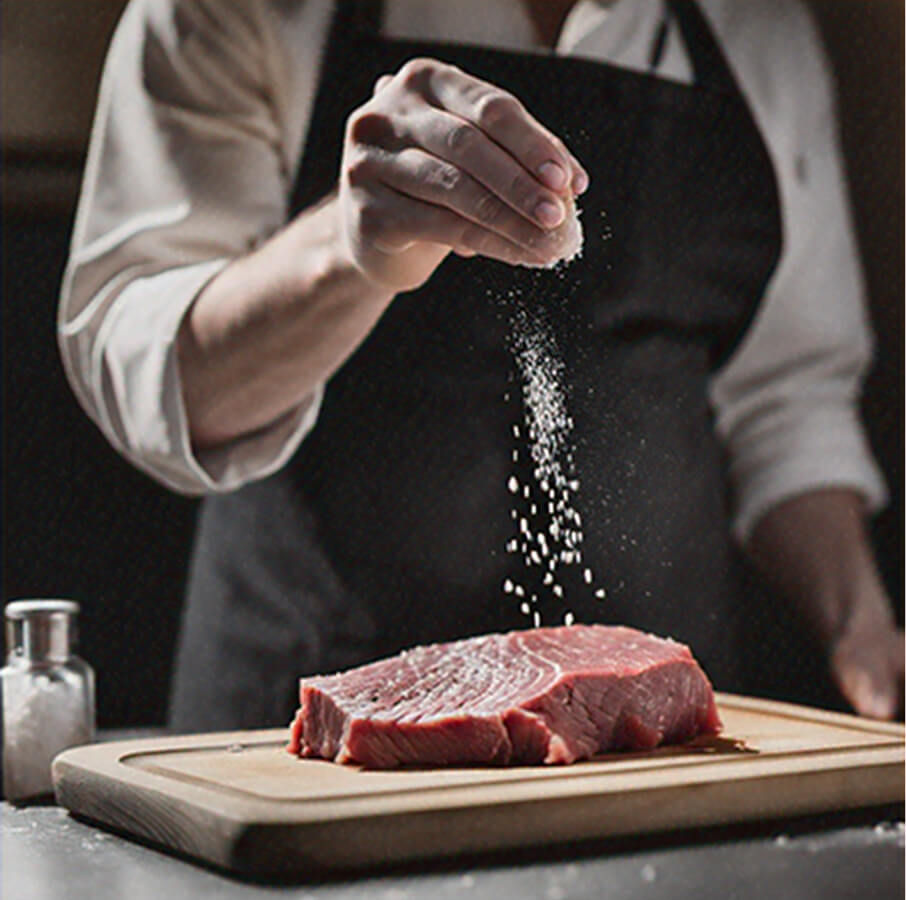
Season the good fresh beef fillets with salt and black pepper. Heat olive oil in a pan over high heat and sear the fillets for 2 minutes per side until it fully browned. Remove the beef from the pan and brush with a thin layer of mustard. Let it cool.
1
Season the good fresh beef fillets with salt and black pepper. Heat olive oil in a pan over high heat and sear the fillets for 2 minutes per side until it fully browned. Remove the beef from the pan and brush with a thin layer of mustard. Let it cool.
1
Season the good fresh beef fillets with salt and black pepper. Heat olive oil in a pan over high heat and sear the fillets for 2 minutes per side until it fully browned. Remove the beef from the pan and brush with a thin layer of mustard. Let it cool.
1
Season the good fresh beef fillets with salt and black pepper. Heat olive oil in a pan over high heat and sear the fillets for 2 minutes per side until it fully browned. Remove the beef from the pan and brush with a thin layer of mustard. Let it cool.
Instructions
Quality Fresh 2 beef fillets ( approximately 14 ounces each )
Quality Fresh 2 beef fillets ( approximately 14 ounces each )
Quality Fresh 2 beef fillets ( approximately 14 ounces each )
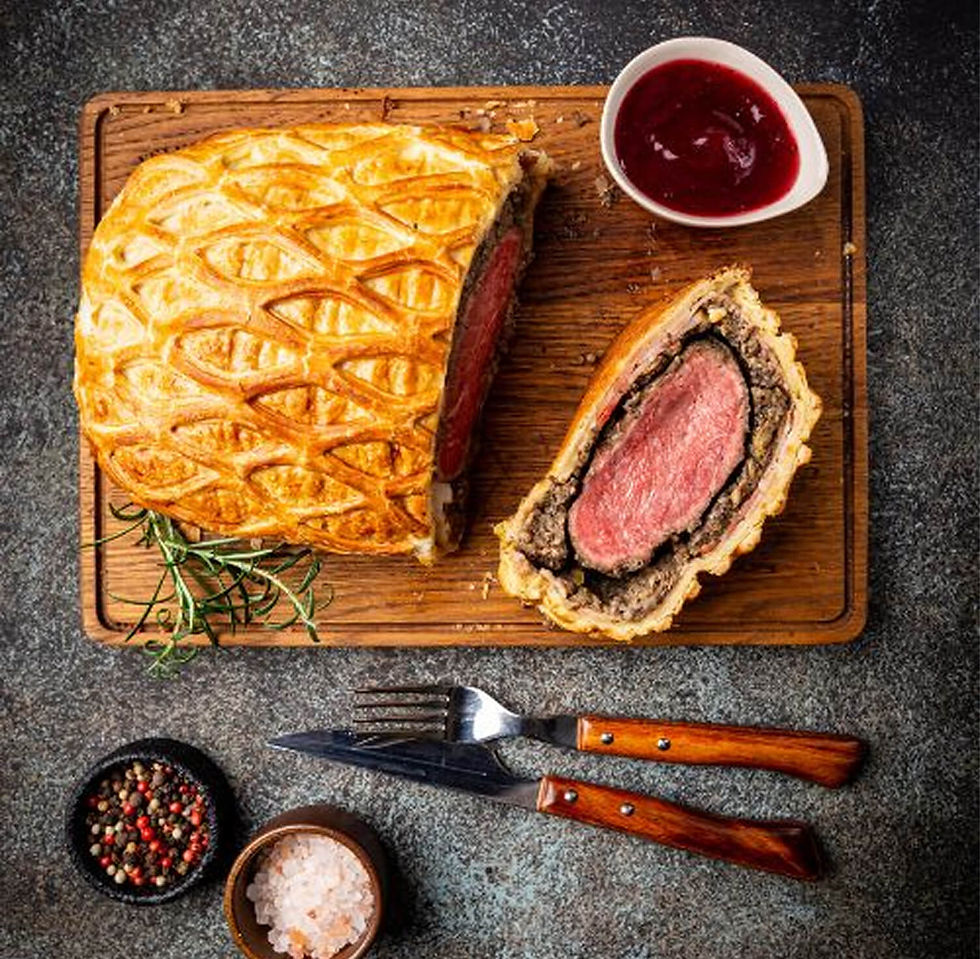
Beef Wellington
Beef Wellington
Fusion Wizard - Rooftop Eatery in Tokyo
Author Name
%20(1).jpg)
Beef Wellington is a luxurious dish featuring tender beef fillet coated with a flavorful mushroom duxelles and wrapped in a golden, flaky puff pastry. Perfect for special occasions, this recipe combines rich flavors and impressive presentation, making it the ultimate centerpiece for any celebration.
Servings :
4 Servings
Calories:
813 calories / Serve
Prep Time
30 mins
Prep Time
30 mins
Prep Time
30 mins
Prep Time
30 mins

$50
Product Title
Product Details goes here with the simple product description and more information can be seen by clicking the see more button. Product Details goes here with the simple product description and more information can be seen by clicking the see more button

$50
Product Title
Product Details goes here with the simple product description and more information can be seen by clicking the see more button. Product Details goes here with the simple product description and more information can be seen by clicking the see more button.
$50
Product Title
Product Details goes here with the simple product description and more information can be seen by clicking the see more button. Product Details goes here with the simple product description and more information can be seen by clicking the see more button.

Comments