How Does Neuroticism Impact Emotional Well-being and Relationships?
One benefit of using the HEXACO is that of the facet of neuroticism within the factor of emotionality: trait neuroticism has been shown to have a moderate positive correlation with people with anxiety and depression. The identification of trait neuroticism on a scale, paired with anxiety, and/or depression is beneficial in a clinical setting for introductory screenings some personality disorders. Because the HEXACO has facets which help identify traits of neuroticism, it is also a helpful indicator of the dark triad.[35][36]
Temperament Assessment
In contrast to personality, i.e. the concept that relates to culturally- and socially-influenced behaviour and cognition, the concept of temperament' refers to biologically and neurochemically-based individual differences in behaviour. Unlike personality, temperament is relatively independent of learning, system of values, national, religious and gender identity and attitudes. There are multiple tests for evaluation of temperament traits (reviewed, for example, in,[37] majority of which were developed arbitrarily from opinions of early psychologists and psychiatrists but not from biological sciences. There are only two temperament tests that were based on neurochemical hypotheses: The Temperament and Character Inventory (TCI) and the Trofimova's Structure of Temperament Questionnaire-Compact (STQ-77).[38] The STQ-77 is based on the neurochemical framework Functional Ensemble of Temperament that summarizes the contribution of main neurochemical (neurotransmitter, hormonal and opioid) systems to behavioural regulation.[37][39][40] The STQ-77 assesses 12 temperament traits linked to the neurochemical components of the FET. The STQ-77 is freely available for non-commercial use in 24 languages for testing in adults and several language versions for testing children [41]
Pseudopsychology (pop psychology) in assessment
Although there have been many great advancements in the field of psychological evaluation, some issues have also developed. One of the main problems in the field is pseudopsychology, also called pop psychology. Psychological evaluation is one of the biggest aspects in pop psychology. In a clinical setting, patients are not aware that they are not receiving correct psychological treatment, and that belief is one of the main foundations of pseudopsychology. It is largely based upon the testimonies of previous patients, the avoidance of peer review (a critical aspect of any science), and poorly set up tests, which can include confusing language or conditions that are left up to interpretation.[42]
Pseudopsychology can also occur when people claim to be psychologists, but lack qualifications.[43] A prime example of this is found in quizzes that can lead to a variety of false conclusions. These can be found in magazines, online, or just about anywhere accessible to the public. They usually consist of a small number of questions designed to tell the participant things about themselves. These often have no research or evidence to back up any claims made by the quizzes.[43]
Ethics
Concerns about privacy, cultural biases, tests that have not been validated, and inappropriate contexts have led groups such as the American Educational Research Association (AERA) and the American Psychological Association (APA) to publish guidelines for examiners in regards to assessment.[9] The American Psychological Association states that a client must give permission to release any of the information that may come from a psychologist.[44] The only exceptions to this are in the case of minors, when the clients are a danger to themselves or others, or if they are applying for a job that requires this information. Also, the issue of privacy occurs during the assessment itself. The client has the right to say as much or little as they would like, however they may feel the need to say more than they want or even may accidentally reveal information they would like to keep private.[9]
Guidelines have been put in place to ensure the psychologist giving the assessments maintains a professional relationship with the client since their relationship can impact the outcomes of the assessment. The examiner's expectations may also influence the client's performance in the assessments.[9]
The validity and reliability of the tests being used also can affect the outcomes of the assessments being used. When psychologists are choosing which assessments they are going to use, they should pick one that will be most effective for what they are looking at. Also, it is important for the psychologists are aware of the possibility of the client, either consciously or unconsciously, faking answers and consider use of tests that have validity scales within them.[9]
1
Searing the Beef
Sear beef fillets on high heat for 2 minutes per side to form a golden crust. Let it cool before proceeding to keep the beef tender.
1
Searing the Beef
Sear beef fillets on high heat for 2 minutes per side to form a golden crust. Let it cool before proceeding to keep the beef tender.
1
Searing the Beef
Sear beef fillets on high heat for 2 minutes per side to form a golden crust. Let it cool before proceeding to keep the beef tender.
1
Searing the Beef
Sear beef fillets on high heat for 2 minutes per side to form a golden crust. Let it cool before proceeding to keep the beef tender.
Notes


1
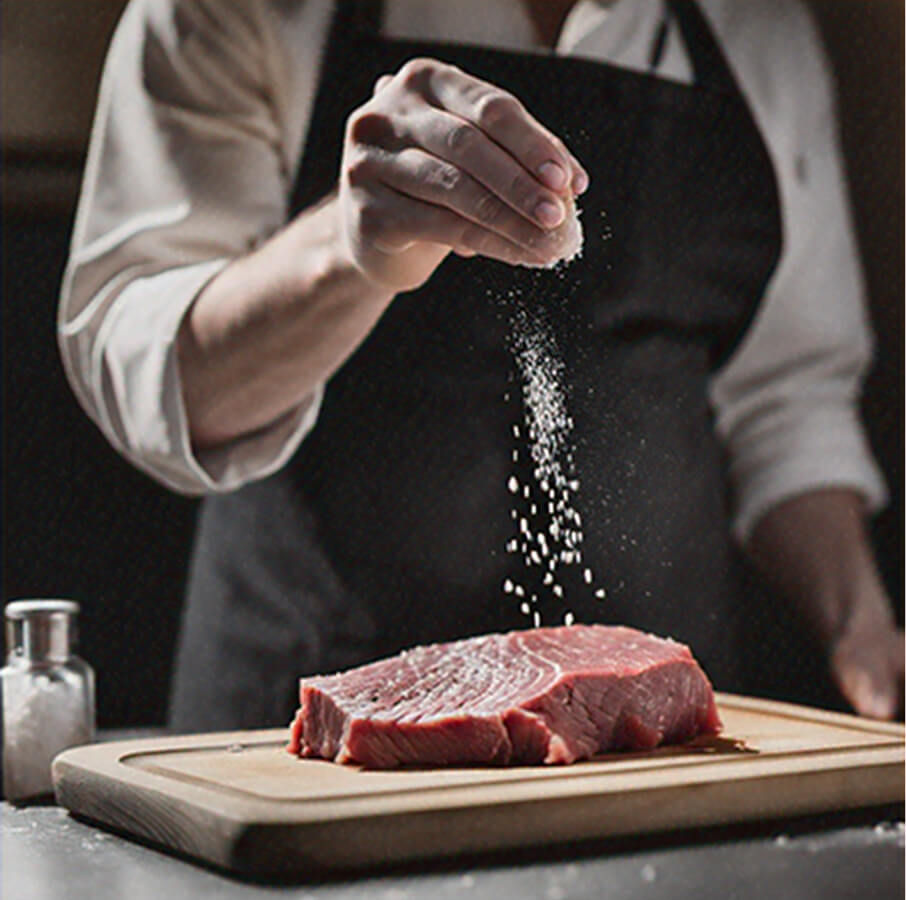
Season the good fresh beef fillets with salt and black pepper. Heat olive oil in a pan over high heat and sear the fillets for 2 minutes per side until it fully browned. Remove the beef from the pan and brush with a thin layer of mustard. Let it cool.
1
Season the good fresh beef fillets with salt and black pepper. Heat olive oil in a pan over high heat and sear the fillets for 2 minutes per side until it fully browned. Remove the beef from the pan and brush with a thin layer of mustard. Let it cool.
1
Season the good fresh beef fillets with salt and black pepper. Heat olive oil in a pan over high heat and sear the fillets for 2 minutes per side until it fully browned. Remove the beef from the pan and brush with a thin layer of mustard. Let it cool.
1
Season the good fresh beef fillets with salt and black pepper. Heat olive oil in a pan over high heat and sear the fillets for 2 minutes per side until it fully browned. Remove the beef from the pan and brush with a thin layer of mustard. Let it cool.
Instructions
Quality Fresh 2 beef fillets ( approximately 14 ounces each )
Quality Fresh 2 beef fillets ( approximately 14 ounces each )
Quality Fresh 2 beef fillets ( approximately 14 ounces each )
Beef Wellington
Beef Wellington
Fusion Wizard - Rooftop Eatery in Tokyo
Author Name
%20(1).jpg)
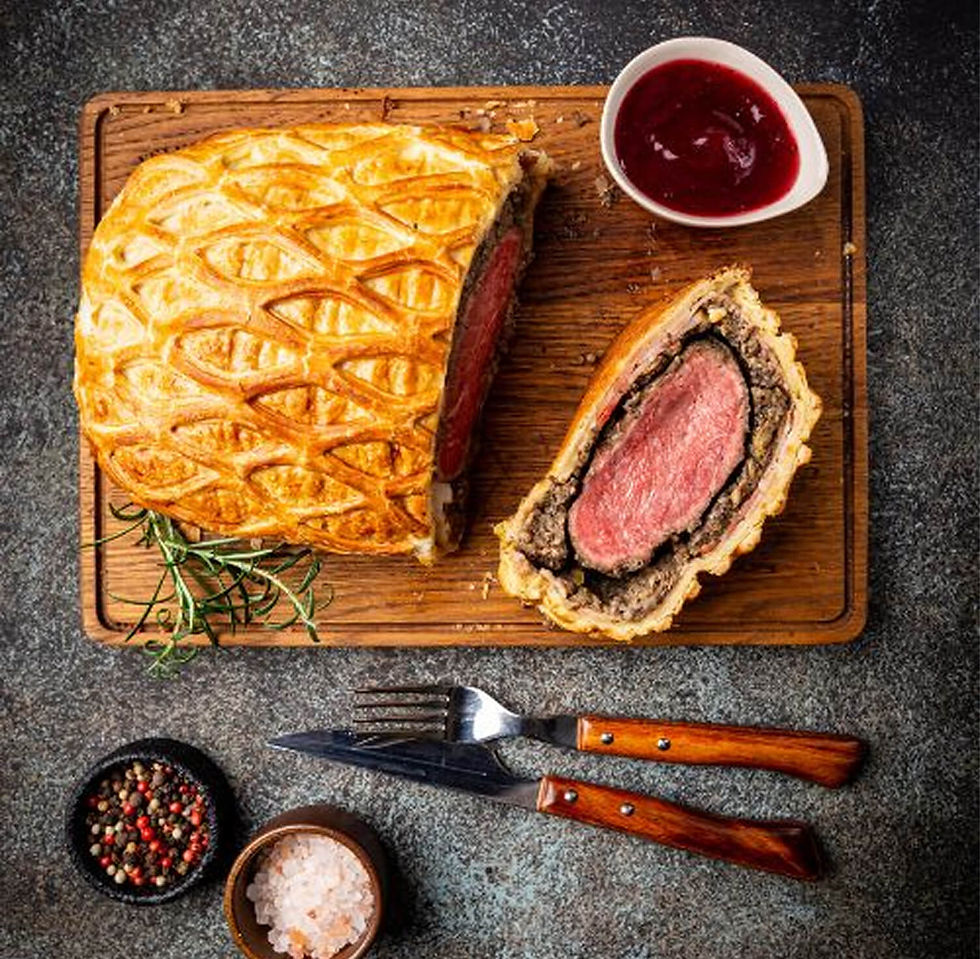
Beef Wellington is a luxurious dish featuring tender beef fillet coated with a flavorful mushroom duxelles and wrapped in a golden, flaky puff pastry. Perfect for special occasions, this recipe combines rich flavors and impressive presentation, making it the ultimate centerpiece for any celebration.
Servings :
4 Servings
Calories:
813 calories / Serve
Prep Time
30 mins
Prep Time
30 mins
Prep Time
30 mins
Prep Time
30 mins

$50
Product Title
Product Details goes here with the simple product description and more information can be seen by clicking the see more button. Product Details goes here with the simple product description and more information can be seen by clicking the see more button

$50
Product Title
Product Details goes here with the simple product description and more information can be seen by clicking the see more button. Product Details goes here with the simple product description and more information can be seen by clicking the see more button.
$50
Product Title
Product Details goes here with the simple product description and more information can be seen by clicking the see more button. Product Details goes here with the simple product description and more information can be seen by clicking the see more button.
![Psychological evaluation is a method to assess an individual's behavior, personality, cognitive abilities, and several other domains.[a][3] A common reason for a psychological evaluation is to identify psychological factors that may be inhibiting a person's ability to think, behave, or regulate emotion functionally or constructively. It is the mental equivalent of physical examination. Other psychological evaluations seek to better understand the individual's unique characteristics or personality to predict things like workplace performance or customer relationship management.[4] History Modern psychological evaluation has been around for roughly 200 years, with roots that stem as far back as 2200 B.C.[5] It started in China, and many psychologists throughout Europe worked to develop methods of testing into the 1900s. The first tests focused on aptitude. Eventually scientists tried to gauge mental processes in patients with brain damage, then children with special needs. Ancient psyc](https://static.wixstatic.com/media/80fb95_dafa432cf926488b8d03b2230d4d4c97~mv2.jpeg/v1/fill/w_200,h_200,al_c,q_80,enc_avif,quality_auto/80fb95_dafa432cf926488b8d03b2230d4d4c97~mv2.jpeg)
![A mental disorder, also referred to as a mental illness,[6] a mental health condition,[7] or a psychiatric disability,[2] is a behavioral or mental pattern that causes significant distress or impairment of personal functioning.[8] A mental disorder is also characterized by a clinically significant disturbance in an individual's cognition, emotional regulation, or behavior, often in a social context.[9][10] Such disturbances may occur as single episodes, may be persistent, or may be relapsing–remitting. There are many different types of mental disorders, with signs and symptoms that vary widely between specific disorders.[10][11] A mental disorder is one aspect of mental health. The causes of mental disorders are often unclear. Theories incorporate findings from a range of fields. Disorders may be associated with particular regions or functions of the brain. Disorders are usually diagnosed or assessed by a mental health professional, such as a clinical psychologist, psychiatrist, psych](https://static.wixstatic.com/media/80fb95_b96a642bf33a4388a4fbc3057da28e36~mv2.jpeg/v1/fill/w_200,h_200,al_c,q_80,enc_avif,quality_auto/80fb95_b96a642bf33a4388a4fbc3057da28e36~mv2.jpeg)
Comments